Life List How To: One Way to Start

It feels a little strange to write about this, because I’m hardly in a position to offer advice right now. Please think of this as something I’m sharing because it helped me sort the army of emotions advancing on my psyche. If you’re feeling equally defenseless in the face of something Big and Bad, or even if you’re just a little befuddled, I hope this will be useful.

Emotions First

When my best-laid plans for my family went awry, my impulse was to respond with a frenzy of planning, and list making, and goal setting.

Instead I napped and took too many baths. Sometimes I napped in the bathtub, which I recommend. Anyway, once I’d restocked enough energy to think about anything but impending doom, I thought now might be a reasonable time to reassess my priorities.

Fortunately, I came across a well-timed article by Martha Beck about using the emotions you’d like to experience to guide your goals (I think it’s the same one Lara mentioned in comments). You look at how you want to feel overall, and then choose activities that support those objectives. I thought it would be a smart organizing principle for deciding what to do next.

Three Steps

First, I needed to figure out how I wanted to feel besides “not like this.” So I did what the article suggested, and here’s how that process unfolded for me:

1. I made a list of all the things I’d like to feel that I’m not right now: content, rested, sane.

2. I decided the main thing I want is more peace, but that seemed too one dimensional, so I made a little outline of all the other emotions that define peace to me. Mine looked like this (forgive the inherent cheese, it’s the nature of the beast):

Peaceful:

Abundant
-Free
-Joyful
-Enthusiastic
-Celebratory

Connected
-Supported
-Loved
-Community

Present
-Aware
-Content
-Curious
-Amazement

Flexible
-Laid Back
-Well Rested

3. Next, for each emotion, I wrote down things that have evoked that feeling in the past. Holy hell, my friends. This was genuinely startling.

I realized how many things I genuinely love that I rarely do. For example, I thought about times I’d experienced joy, and I kept coming back to swimming. I particularly love swimming in natural bodies of water, and I almost never do it. This is ridiculous because we have a cabin a block from a river. Apparently I’ve been denying myself joy because it’s too much of a pain. Joy gets too much sand in the car.

I also realized how many mundane bits of happiness I needlessly deny myself. I used to love getting dressed in the morning, especially if I was feeling blue. Looking pulled together is like armor, it makes me feel so much more confident. Over the years, as my schedule has shifted to accommodate the people around me, I started to rush through grooming, to be stressed about how long it took. I stopped ironing, resisted the urge to change an outfit that wasn’t working. Getting ready in the morning became a chore, because I felt like everyone was waiting on me. Now when I feel time stress rising, I stop myself and think, “You enjoy this.” And I let my shoulders unhunch.

What’s Your Question?

The best thing about this process is that, for a while at least, it has given me a single question to ask myself about any decision in front of me. Will this make me feel more peaceful? If the answer is no, it’s off the list.

I need to make more time for water.

What’s the question you ask yourself before you make decisions? Or do you have another guiding principle for goal setting? I’m all ears.

Flashback Monday: Give Me a Sign

In an effort to gather all my writing in one place, I’ve been posting articles that originally appeared elsewhere. This piece was published by the The Morning News in 2004, when I worked at the Democratic National Convention as the volunteer coordinator for the Kerry Campaign, and a visibility whip on the convention floor.
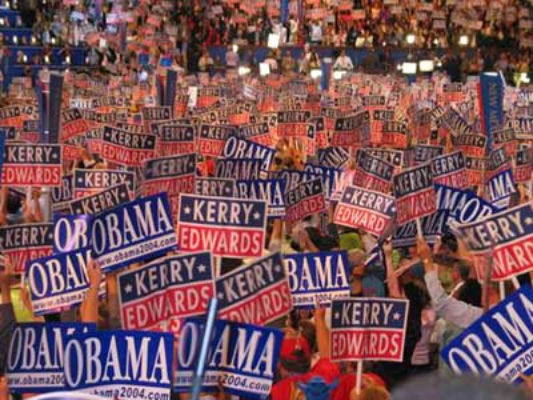
Political conventions exist for the cameras, and the cameras like to see audiences with a sea of signs. But where do all those banners come from? Margaret Mason outlines the life cycle of a rally sign.

Illinois is yelling at me. I’m on the floor of the Democratic National Convention, waiting for my signal to pass out signs to three different states. But Illinois would like to have them now. All of them. I get my cue and start passing.

As I hand out the signs, my underpants begin hiking up. My arms are overfull, and I’m surrounded by thousands of people. By the time I finish, my underwear is well above the line of my pants—and Illinois is still screaming. I turn around and see a CNN cameraman filming me from behind.

For most of the past decade I’ve been a full-time writer and editor. I’ve logged a lot of quality time with teacups and tidy desks. As I’ve told many friends, working at the convention is a lot like emerging from a comfortable, warm bath, drying off, and then hopping into a vat of ferrets.

Whip it Good
“Visibility whips” are the volunteers who distribute signs and small souvenirs on the convention floor. This is my job. One of the job requirements is the ability to break into a full sprint whenever necessary.

After our first few sign passes, we learn to hold them so we don’t get nasty paper cuts on our forearms when someone grabs them unexpectedly. We also learn how to say “excuse me” so it never sounds like a request. Mostly, we exchange uneasy glances when we learn we’re passing out convention souvenirs rather than signs. We call the souvenirs “chum,” as in the hunks of raw meat you throw into the water to churn up sharks. Everyone’s clamoring for signs, but even statesmen in somber suits will maim each other for a keychain flashlight.

Flag Waving
Our timeline for the speeches is rough because many run long. (You may remember how Al Sharpton’s six minutes stretched into 20.) Whips wait in the entry halls and then move into our sections when it’s about time for a new round of signs.

In many cases, this means that we’re standing within the crowd for ten minutes or so while the speaker finishes a speech. This is when things get a little heated. The crowd sees what we’re about to hand out, and they begin to flock.

I have a precarious embrace around 500 small American flags. Several people try to snatch a bundle or two from my arms without asking. I reserve my nastiest looks for these folks; I am disappointed in them.

When I begin to pass the flags, many people stand, gesture frantically, and call out to me. Of course, there aren’t enough flags for everyone, and most people understand that this is just the way it is. Still, when my arms are empty, I hear one man’s voice above the crowd. “Girl!” he yells. “GIRL!”

My spine tightens, and I turn slowly to find the gentleman a few rows back. When he sees he’s caught my attention, he pops his eyes and flexes his jaw. The effect is comedic, crazed, and disproportionately intense. I am briefly grateful he had to pass through a metal detector to be here.

Fingers splayed, he gestures in wide circles toward his chest, like a magician willing his hypnotized subject to come forward. He wants to talk to me. He wants to chat about how he did not get a flag.

I blink at him in disbelief, then laugh and trudge back upstairs to gather signs for the next push.

Signed, Sealed, Delivered
Over four days, we’ll pass out 169,932 signs (those last two are extra-large posters for New Mexico’s governor Bill Richardson). Most are mass-produced—the ones that nod in a sea of approval during major speeches.

The whips are here to help ensure that there are no “sign clots” or empty rows when a network camera scans our section. The audience needs to have signs at the exact right moment, needs to know when to hold them up, and needs to know when to put them down. As you might imagine, producing and dispersing these signs—and providing instructions to go with them—is no small organizational task.

First off, because the Secret Service is a bit touchy about these things, the signs must be made in such a way that no one can use them as weapons. That means no wooden stakes as signposts. Shelly, the floor manager for many a past convention, special orders thousands of miniature mailing tubes for signposts instead.

Also, because the fire marshal isn’t keen on having huge piles of highly flammable paper signs in the building, each night’s signs are stored in large trucks outside. These are unloaded in the mornings and placed in holding rooms backstage.

No Rest for the Weary
My husband Bryan has been working in event production for years. He’s taken two weeks off work to be here, as a visibility manager, which means he helps organize and run the sign operation. The weekend before the convention his team realizes there’s a problem.

The signs are safe in their trucks and ready to go, except for one small thing: In the chaos of sign construction, everyone has been tossing signs into the trucks willy-nilly. This is an organizational nightmare. Each truck should be loaded with signs for a particular day, so they can be stored and unloaded easily.

So now each of the three trucks must be reloaded so it contains the signs for its assigned night. Unfortunately, nearly all of the signs are wrapped in opaque garbage bags, which means that the bags must be ripped open, the signs identified—and sometimes re-bagged—before they can be loaded into the correct truck.

Once that problem is solved, a new one emerges. Some of the signs are late coming back from the printer, and, on the eve of the convention, someone needs to go get them. Unfortunately, the area around the Fleet Center has already been secured by the Secret Service. The Secret Service, it seems, isn’t fond of large trucks driving into its secured areas.

Bryan picks up the signs, and drives them back to the Secret Service Marshalling Yard. There, he waits until midnight to be processed. He drives the truck through a huge X-ray machine (farewell, viable sperm), and then waits as a bomb-sniffing dog examines the vehicle. It sniffs the bumper, the engine, Bryan’s bag, Bryan’s shoes, the glove compartment, and each bag of signs in the back.

Several hours later, a police officer escorts Bryan and the signs into the secure area and volunteers begin unloading them. That morning, I meet Bryan with a freshly ironed shirt and a cup of coffee. And he’s ready for a new day.

The System
The convention hall is divided into about nine major zones. Each zone has a coordinator, who is in radio contact with the two visibility managers, who give the cues. The zone coordinators each have a team of about five visibility whips.

In the afternoon before opening night, zone coordinators receive rough timelines that indicate cues for when the signs should go up. Coordinators gather their whips and take signs from the large holding areas over to mini staging rooms closer to their zones. At about 4 p.m., the action starts.

We wait in our staging areas until the zone coordinators get a radio call to move into position. In some areas of the hall, the radios aren’t working as well as they should be. The visibility managers shout, “GO-GO-GO-GO-GO-GO-GO-GO-GO!” when it’s time to pass the signs. The idea is that at least one or two “GOs” will get through the spotty reception and to the zone coordinators.

When coordinators hear “the go,” they signal to the team. At this point, the visibility whips (that’s me) give about half the signs to political and delegate whips, who are associated with the individual states, and the rest of the signs they pass out directly to the audience.

We pass the signs with instructions, “Raise this when Mrs. Edwards gets onstage, please” or “Wave your flag when Willie Nelson sings.” This message is reinforced by the political whips, who also get radio instructions from backstage. After that, we cross our fingers.

Do You Know Who I Am?
On the final day, the visibility team realizes that the tall vertical signs in front of the podium will block the photographers’ shots of Kerry during his speech. Twenty-five volunteers spend an hour trimming sign handles with X-Acto blades.

That night, the fire marshal closes the floor early. We get advance warning and are told to get as many signs as possible into the auditorium before we’re shut out.

We have about half the signs inside before the floor closes, and most of us are stranded outside. We go to each door looking for sympathetic security checkers. At this point, only a quarter of our team is on the floor for the sign passes.

A locked-out delegate sees me rushing around in my yellow safety vest and assumes I have authority.

“They’re not letting anyone on the floor!” he yells.

“I know, I’m so sorry. The fire marshal shut things down because there’s too many bodies.”

“Do you know who I am?”

“I don’t, sir.”

“I have to be out there!”

“I’m so sorry, sir.”

“Don’t be sorry. Do something about it.”

“Sir, I have zero power.”

“Well, who the hell does have power?”

“The fire marshal.”

“Well you tell your superiors that I’m locked out. You just tell them and see what they have to say about that.”

“Yes, sir.”

He wanders back to the door, too flustered to realize that I still don’t know who he is. He turns his tirade on an 18-year-old security volunteer, who shakes her head a few times and then avoids eye contact.

Where Are the Balloons?
Despite the frantic pace and the aching muscles, the convention has hundreds of small beautiful moments that make everything worthwhile.

On our second flag pass, I decide to test a theory. As I give people the flags I say, “There won’t be enough of these for everyone. We’ll need to be kind to each other.” Each person smiles at me, mumbles “of course,” and passes the flags along politely. Magic.

A few times a night, everyone in the convention hall sings something in unison. There’s nothing so lovely as thousands of people singing “America the Beautiful.” Then again, I also find myself tearing up at everyone dancing and singing along to “Johnny B. Goode.” Of course, by this point I haven’t really slept in a week. On occasion we pass out handmade signs drawn in thick Crayola marker; Kids for Kerry has been working on them for weeks. They say things like, “Kerry is da’ man!” or “Kerry rocks my socks” with a small drawing of argyle socks in the corner. In the back room, we read through every one.

For every creep on the floor, there’s someone who pats me on the back and tells me what a good job I’m doing. Guam gives me an enamel pin because I make sure they get signs in the far back corner. A few nights later, I get a pin from West Virginia. “West Virginia loves you,” the delegate says. I think West Virginia may be tipsy.

Pausing to look out as everyone raises the signs, my breath catches. When Teresa Heinz Kerry walks on stage to see the field of bobbing “We love Teresa!” signs, my friend Birgitte grabs my arm. “Do you see how touched she is? We did that. We did that!”

And it’s true. When everything goes as planned, the effect can be breathtaking: thousands of people who have come to the same conclusion at the same moment, thousands of people who couldn’t agree more. All of us would like a new president, please.

Thanks to You

Thank you, friends. You’ve made the last couple of days so much better than they would have been without you. Thank you for all of your support, for telling me you were holding my hand, hugging me, keeping me in your thoughts, for offering your guest rooms, hot water bottles, and shoulders. Most of all, thank you for making me feel safe enough to share things with you online. Here’s why that continues to be true.

All of you are part of a community that can leave more than 300 comments on an emotionally sensitive topic, and every last one of you offered support. Not a single comment increased the pain we’re going through — I didn’t have to use the delete button, no one ended up blocked, no one was even a little bit sarcastic. To a person, you have been incredibly gentle, and more gracious than I ever dared to hope.

Thank you for your kindness.

Bad News

Hi everyone, I have some painful news. I’ve resisted writing this because it feels so final, but here goes. Bryan and I are separated.

I know this will come as a surprise to many of you, as it has to some of our friends. We’re both of the fine, thanks! camp, which is ideal for soldiering on, but confusing when your eyes well up.

Hank is doing well, we both get to see him every day, and Bryan and I are working on rebuilding a friendship. Bryan continues to be an amazing dad, and he will always be family. In addition to Hank, we still share a group of supportive, understanding friends, so please don’t be confused if he shows up in photos now and again. We’re both trying to be grownups.

Thank you to those of you who have sent concerned emails about my occasional absences lately. I feel less dazed every day, but I still start when I notice the space where my wedding ring used to be. I so regret not having the emotional resources to do my best work here lately. I’m sorry about that, and I hope you’ll give me a chance to make it up to you.

I’ve written a lot here about my dreams, and though this wasn’t part of my dream for my family, it has certainly been transformative.

In the last week or so I’ve finally felt solid enough to put together a plan, and while I still have all kinds of things I want to do, I’m also thinking more about how I’d like to feel and what I’d like to give. So let’s talk about all that good stuff in the coming week.

In the meantime, I owe you thanks for having been such a positive force in my life over the years. Thanks for being here with me in this upsetting time, just as you’ve celebrated with me in the happy moments. For those of you who are going through something difficult, I hope I can make you feel a little less alone too.

Here’s to more joy in all of our futures.

Hooray for Your Life Lists

Oh, team, we care crossing stuff off like gangbusters. Let’s celebrate together. Three cheers for:

Ashely from High Brow, who kicked off a reading series. “I knew a reading series would be a ton of work, but I never imagined it would really feel like a mini version of making a movie.”

Lauren from I’m Better in Real Life is working in the writing industry. “This was something I figured would be marked off 10?20 years? down the road.”

Sara of Fight for Joie acquired a Dyson. “This year is going to be so clean.”

What about you? Have you been working on anything to move your life toward awesome? Tell us. Tell us!

Flashback Monday: Life Lessons in Literature

In an effort to gather all my writing in one place, I’ve been posting articles that originally appeared elsewhere. This piece was published by the The Morning News in 2003.

Where were you when the family car broke down, when you first heard about oral sex, when you chose a political party? More importantly, what were you reading?

Book: The Holy Bible
Lesson: Don’t touch your sister’s stuff.

My family is not religious. There are no Bible stories at bedtime, no prayers before bed. My sister Raina’s bible was given to her at birth. To me, it is simply a giant, gilt-edged book with gold letters on the cover. It is shiny and heavy, and therefore compelling. At age two, I toddle into Raina’s room and yank a few pages out. Raina is eight, and she is displeased. The Holy Bible has driven us apart. My sister decides that she needs some baby-free space. From then on, it is a house rule that I am not allowed in Raina’s room unless she invites me.

Over the years, Raina teaches me to swim by bribing me with Ritz crackers, and holds on to the back of my bike as I wobble up the street, but she never feels particularly inclined to invite me into her room. When she moves out about a decade later, her bigger, sunnier room is passed on to me. I enter with an awed silence. I have almost no idea what it looks like.

Book: Island of the Blue Dolphins, by Scott O’Dell
Lesson: Don’t eat the red ones.

This book got me thinking about how I would survive if I ended up in the wild fending for myself. Thus began the gathering phase of my childhood. I took all of the cereal bowls; filled them with pyracantha berries, crab apples, and mud pies; then hid them in the backyard. Mom found a bowl full of poisonous plants and screeched.

‘Have you been eating these!’

‘No. I’m saving them.’

‘For what?’

‘For later.’

‘Don’t eat these.’

‘OK.’

Mom bought a new set of bowls. I began to collect oleander blossoms.

Book: A Little Princess, by Frances Hodgson Burnett
Lesson: Check the oil.

We take a trip to our local Tower of Books where I pick A Little Princess off the shelf. The cover is pink (like my room), and has an illustration of a small girl with long brown hair. I read it twenty-one times, and the cover falls off. When mom decides we need a road trip after my dad dies, I pack it in my box of books. She loads my sister and me into a big van with a mattress in the back, and we sweat through most of the western states. My sister applies headphones, and I read a girl-shaped dent into the mattress.

The Grand Canyon is 121 degrees in the shade. Our insufferable tour guide tells a joke about a man who rides his horse off a cliff, and I throw up over the side of the tram. The van conks on our way home. We’re stranded in Seligman, Arizona, and Mom makes arrangements to fly back to California. She refuses to ship the huge box of books I’ve accumulated by then, insisting that I leave them with the granddaughter of the local motel owner. I pass my precious books to her one by one, explaining each plot, some character summary. She blinks at me, obviously bored. ‘Quite a bookworm, aren’cha?’ I shove the box at her and walk back to our room.

Book: Valley of the Horses, by Jean M. Auel
Lesson: It’s not the message, it’s the medium.

Mom and I begin reading Valley of the Horses at the same time. She reads ahead of me and decides that some of the content is ‘not age-appropriate.’ She is correct, as I learn after sneaking into her room and reading her copy in snippets while she’s running errands. A few weeks later, I get to thinking.

‘How do gay guys have sex, mom?’

She inhales, exhales, looks at me in the rear view mirror.

‘Well. I’m very uncomfortable telling you this.’

She looks back at the road, perhaps waiting for me to withdraw the question. I remain expectant.

‘Shit. OK, they say that if you’re old enough to ask the question, you’re old enough to know the answer.’

‘OK.’

‘Gay men have sex in the butt, Margaret.’

‘…Oh.’

That night, I find the book on my pillow. I mark the good pages and hide it under my bed.

Book: Miss Manners Guide to Excruciatingly Correct Behavior, by Judith Martin
Lesson: Sex sells.

My high school English teacher asks us to present our favorite book to the class, and says she’ll have our peers grade our work. I choose Miss Manners Guide to Excruciatingly Correct Behavior, knowing that I’ll be mocked. But this book fascinates me. I decide to present it as I see it, as an anthropology book about us: our customs, preferences, and cultural quirks. I take the podium, ready to explain how weird etiquette is, how odd it is that we have entire books to tell us how to avoid offending other people.

The boys in the classroom are, not surprisingly, ignoring me. Amy Grimshaw has forgotten to cross her ankles. Each of the boys has his head tilted slightly to the right so as to overcome the minor obstacle of Amy’s cheerleading skirt. I receive an A.

Book: Backlash by Susan Faludi
Lessons: I am not a Republican.

Eric asks if I can drop off my notes, and when I get there he asks if I want some wine. I do. He wants to talk politics. He’s a Republican. Really? I am too. Do I want more wine? I do. He says that if people want to have kids, someone should be prepared to stay home and take care of them. I agree. He settles in next to me on the couch and pours more wine. And if men make more money, he says, doesn’t it just make sense that the women should be the ones taking care of the kids?

Well, I suppose it does… But if women were getting equal pay for equal work, then couldn’t you choose the parent best suited to caring for the kid? I mean, there are a lot of really nurturing men out there. I mean, I’ve met some women who have no business being full-time moms. And shouldn’t the right-wing female proselytizers, who are spending well more than eight hours a day preaching that women should be staying home with the kids, just take their own advice and leave the rest of us out of it? And doesn’t he want to marry a woman who’s smart and capable enough to make just as much as he is? And in a time when engineering jobs are among the most lucrative, did he ever have a toy that said ‘Math is hard!’ and giggled? And did he ever have an insipid, anachronistic band teacher who told him that he should play the flute because his hands were just too darn small for the saxophone? Well, did he? Did he?

Book: Where the Wild Things Are, by Maurice Sendak
Lesson: I want a family.

In college, I date a man who has a beautiful son. I give the baby a bath before bedtime, and then read to him as he falls asleep. There are a few pages in the middle of Where the Wild Things Are that have no words, just illustrations of wild things cavorting about with their terrible claws and terrible teeth. James is half asleep when we get to this part, but he lifts his head a few inches and points at the monster that’s jumping and growling beneath the moon. He taps the drawing and whispers, ‘He try to get the moon.’