The Sun Also Rises by Ernest Hemingway

Oof. Now I have to read everything by Hemingway. The best parts of The Sun Also Rises:

As he had been thinking for months about leaving his wife and had not done it because it would be too cruel to deprive her of himself, her departure was a very healthful shock.

It is very important to discover graceful exits like that in the newspaper business, where it is such an important part of the ethics that you should never seem to be working.

After supper we went up-stairs and smoked and read in bed to keep warm. Once in the night I woke and heard the wind blowing. It felt good to be warm and in bed.

Montoya could forgive anything of a bull-figher who had aficion. He could forgive attacks of nerves, panic, bad unexplainable actions, all sorts of lapses. For one who had aficion he could forgive anything. At once he forgave me all my friends.

Brett was happy. Mike had a way of getting an intensity of feeling into shaking hands. Robert Cohn shook hands because we were back.

“Oh to hell with him.”
“He spends a lot of time there.”
“I want him to stay there.”

“Brett will tell you. She tells all the stories that reflect discredit on me.”

“I’ve always done just what I wanted.”
“I know.”
“I do feel such a bitch.”
“Well,” I said.

Walking across the square to the hotel everything looked new and changed. I had never seen the trees before. I had never see the flagpoles before, nor the front of the theater. It was all different. I felt as I felt once coming home from an out-of-town football game. I was carrying a suitcase with my football things in it, and I walked up the street from the station in the town I had lived in all my life and it was all new. They were raking the lawns and burning the leaves in the road, and I stopped for a long time and watched. It was all strange. Then I went on, and my feet seemed to be a long way off, and everything seemed to come from a long way off, and I could hear my feet walking a great distance away. I had been kicked in the head early in the time. It was like that crossing the square. It was like that going up the stairs in the hotel. Going up the stairs took a long time, and I had the feeling that I was carrying my suitcase.

Never once did he look up. He made it stronger that way, and did it for himself, too, as well as for her. Because he did not look up to ask if it pleased her he did it all for himself inside, and it strengthened him, and yet he did it for her, too. But he did not do it for her at any loss to himself. He gained by it all through the afternoon.

The three of us sat at the table, and it seemed as though about six people were missing.

ON INEBRIATION

“Tight!” Brett exclaimed. “You were blind!”

“Hello, Jake,” he said very slowly. “I’m getting a lit tle sleep. I’ve want ed a lit tle sleep for a long time.”

WINNING PHRASES

“What rot.”

I said I would go with him, just to devil him.

“Direct action,” said Bill. “It beats legislation.”

“Bill’s a yell of laughter.”

“Oh, shove it along, Michael.”

VOCABULARY

quais – the area of a city (such as a harbor or dockyard) alongside a body of water
bateau mouche – a pleasure boat that takes sightseers on the Seine in Paris
darbs – 1920s, A person with ready money, who can always be relied upon to pay the check.
Mencken – American editor and critic. A founder and editor (1924-1933) of the American Mercury, he wrote socially critical essays, often directed toward the complacent middle class.
encierro – running of the bulls

Play it as it Lays by Joan Didion

I’ll read anything by Joan Didion because she’s so skilled, but this is not an uplifting work. I once made the mistake of reading Metamorphosis on a beach vacation. Similarly, Play it as it Lays does not belong anywhere near sand. I had to skip Chapter 25. I know I probably cheated myself there, and yet. Still, you should read it. It’s very good.

The best parts of Joan Didion’s Play it as it Lays:

NOTHING APPLIES, I print with the magnetized IBM pencil. What does apply, they ask later, as if the word “nothing” were ambiguous, open to interpretation, a questionable fragment of an Icelandic rune.

…just the snakes stretched out on the warm asphalt and my mother with a wilted gardenia in her dark hair and my father keeping a fifth of Jim Beam on the floorboard and talking about his plans, he always had a lot of plans, I never in my life had any plans none of it makes any sense, none of it adds up.

I’m not crazy about a lot of people. I mean maybe I was holding all the aces, but what was the game?

He was watching a very young girl in a white halter dress dancing on the terrace.
“I’d like to get into that,” he said contemplatively to BZ.
“I wouldn’t call it the impossible dream,” BZ said.

Only by an increased immobility did he acknowledge her presence.

She knew all the indices to the idle lonely, never bought a small tube of toothpaste, never dropped a magazine in her shopping cart. The house in Beverly Hills overflowed with sugar, corn-muffin mix, frozen roasts and Spanish onions. Maria ate cottage cheese.

All the daisies in the garden had been snapped by the wind.

…the infant in the driveway, rattlesnake in the playpen, the peril, unspeakable peril, in the everyday.

By the time Carter came back to town in February the dialogue was drained of energy, the marriage lanced.

By the end of the week, she was thinking constantly about where her body stopped and the air bgan, about the exat point in space and time that was the difference between Maria and other.

In the heat of some mornings she would wake with her eyes swollen and heavy and she would wonder if she had been crying.

Vocabulary
Krait — A highly venomous Asian snake (genus Bungarus) of the cobra family.
presentiment — An intuitive feeling about the future, esp. one of foreboding.
Macht nicht –An American spelling of the German expression “macht nichts” which means roughly, “it makes no difference.”
wen — Pathology a benign encysted tumor of the skin, especially on the scalp, containing sebaceous matter; a sebaceous cyst.

Note to self:
See Ingrid Bergman in Gaslight

Best parts of other books by Joan Didion:
The Year of Magical Thinking
Blue Nights
Democracy

Ed note: Ha! Just went to set this on my bookshelf and realized I already owned a copy. I attempted this one years ago, and abandoned the effort on page 40. Good thing I have a terrible memory for titles. Also, this was made into what looks like an awful movie in 1972.

Interview with Pamela Druckerman, author of Bébé Day by Day: 100 Keys to French Parenting

Tonight, Go Mighty is hosting a book party in NYC for Pamela Druckerman, author of Bébé Day by Day: 100 Keys to French Parenting. Druckerman is a former staff reporter for The Wall Street Journal, who currently lives in Paris with her husband and children. You may remember her previous book, international bestseller Bringing Up Bébé, which had American parents asking, “How did you get your kid to eat that?” I asked her a few more questions about her new book.

When you moved to Paris, what aspect of family life gave you the greatest sense of culture shock?

It was the fact that worrying and anxiety weren’t encouraged, or seen as a sign that that you’re a good parent. In France, from the time you get pregnant, what’s valorized is calm. Of course all pregnant women worry, wherever they live. But French pregnancy magazines run articles about the importance of “serenity,” and how a pregnant “Zen maman” will give birth to a “bébé Zen.” For a neurotic New Yorker, all this talk of calm was unnerving.

You also say that French mothers have a different relationship toward guilt than their American counterparts. How does that manifest?

Guilt, like anxiety, is valorized in America. It’s viewed as a sign that you really care about your kids, and a check on becoming too selfish.

French moms do battle with guilt too. But they do it differently. They don’t valorize guilt. They think guilt is unhealthy and unpleasant, and they try to banish it. When French mothers get together, they say things like, “The perfect mother doesn’t exist.”

And the French let their children “curse?”

French preschoolers have their own curse word: caca boudin. This roughly translates as “poop sausage.” It’s an all-purpose bad word that can mean “no,” “I don’t care,” or “whatever.” My kids liked to shout it as a declaration of freedom.

When you return to The States, which accepted parenting practice surprises you now?

I’m sad when I see kids shunted into a kids’ food ghetto, where they’re fed grilled cheese and chicken nuggets. I also can’t get over all the snacking. I want to walk up to the moms who are handing out cookies in the park and say, “And you wonder why he doesn’t eat at lunch!” But I’m not the person who does that. I’m the person who goes home and writes a book about it.

How do the French address issues of sexuality in the face of a new baby, and the idea of being sexual as a mother in general?

Well for starters, calling it “the issue of sexuality” is not very sexy! Shall we just call it sex? The French believe that for about the first three months post-partum, it’s all hands on deck for the baby. Some call this, presidentially, the first hundred days. But after that, mom and dad are expected to start gradually “finding their couple” again. It’s a kind of rebalancing.

Which idea has transformed the way you parent most dramatically?

It’s a small thing, but I think the “no interrupting” principle makes a very big difference in daily life. The idea is that if a child interrupts you, you turn to him and politely say something to the effect of, “I’m speaking with someone else, I’ll be with you in a minute.” This respect is supposed to go both ways. If the child is absorbed and happily playing, the adult isn’t supposed to interrupt him either.

Which tip do you have the most trouble following yourself?

The no-snacking rule, especially when I’m working from home. Does tea count as a snack? Does an entire baguette?

****
Thanks Pamela, and since when did bread count as a “snack?” I’m pretty sure it’s just what you do with your hands before the entrée arrives. Remember your roots! And congrats on the new book.

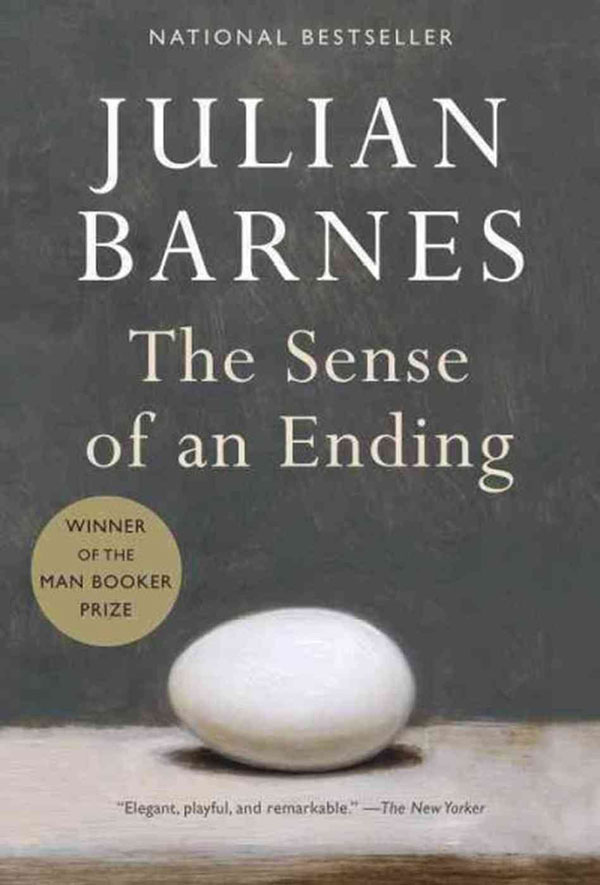
The Sense of an Ending by Julian Barnes

The best parts of The Sense of an Ending by Julian Barnes:

Marshall was a cautious know-nothing who lacked the inventiveness of true ignorance.

When I was going out with her, it always seemed that her actions were instinctive. But then I was resistant to the whole idea that women were or could be manipulative. This may tell you more about me than it does about her.

History isn’t the lies of the victors… I know that now. It’s more the memories of the survivors, most of whom are neither victorious nor defeated.

… You begin to understand that the reward of merit is not life’s business.

Margaret used to say that there were two kinds of women: those with clear edges to them, and those who implied mystery.

…a crocodile of ex-girlfriends all lined up.

And so, for the first time, I began to feel a more general remorse — a feeling somewhere between self-pity and self-hatred — about my whole life. All of it. I had lost the friends of my youth. I had lost the love of my wife. I had abandoned the ambitions I had entertained. I had wanted life not to bother me too much, and had succeeded — and how pitiful that was.

Sorry, no, you can’t blame your dead parents, or having brothers and sisters, or not having them, or your genes or society, or whatever — not in normal circumstances. Start with the notion that yours is the sole responsibility unless there’s powerful evidence to the contrary.

VOCABULARY

Berk – Come from the Cockney rhyming slang “Berkshire Hunt” = Cunt.

Plimsole – Slang for someone who isn’t up to snuff academically or culturally.

Severn Bore – A tidal bore seen on the tidal reaches of the River Severn in England. Phenomenon in which the leading edge of the incoming tide forms a wave of water that travels up a river or narrow bay against the direction of the river or bay’s current.

fossicking – rummaging or searching around

clubbable – Suitable for membership of a club because of one’s sociability or popularity.

exegesis – exposition, explanation; especially : an explanation or critical interpretation of a text

nous – Reason and knowledge as opposed to sense perception.

chippy – resentful or oversensitive about being perceived as inferior

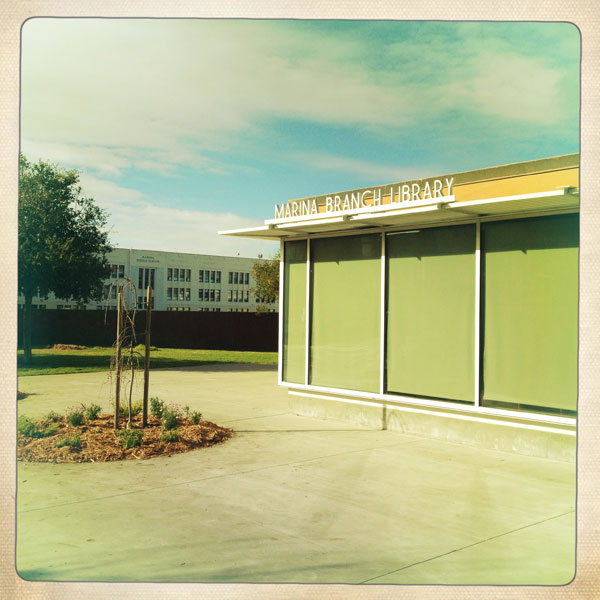
San Francisco Library Portraits Project: Marina Branch

As part of my Life List, I’m photographing all the public libraries in San Francisco.

If you’d like to write a letter to help preserve Californina library funding, you’ll find some addresses here.

More Library Portraits:
Library Portraits Project: Mission Bay

Library Portraits Project: Main Branch
Library Portraits Project: Golden Gate Valley Branch
Library Portraits Project: Potrero Branch
Library Images from Around the World

The Best Parts of A Visit from the Goon Squad by Jennifer Egan

“He’s rigged a tiny cassette player with a small set of foam earphones to listen to demo tapes and rough mixes. Occasionally he’ll hand the device to Mindy, wanting her opinion, and each time, the experience of music pouring directly against her eardrums — hers alone — is a shock that makes her eyes well up; the privacy of it, the way it transforms her surroundings into a golden montage…”

“I should go, Dad,” Chris said. Bennie let him out of the car and hugged him hard. As always, Chris went still in his embrace , but whether he was savoring it or enduring it Bennie could never tell.”

“Yet each disappointment Ted felt in his wife, each incremental deflation, was accompanied by a seizure of guilt; many years ago, he had taken the passion he felt for Susan, and folded it in half, so he no longer had a drowning, helpless feeling when he glimpsed her beside him in bed: her ropy arms and soft, generous ass. Then he folded it in half again, so when he felt desire for Susan, it no longer brought with it an edgy terror of never being satisfied… Susan was baffled at first, then distraught… but eventually a sort of amnesia had overtaken Susan; her rebellion and hurt had melted away, deliquesced into a sweet, eternal sunniness that was terrible in the way that life would be terrible, Ted supposed, without death to give it gravitas and shape.”

“I looked down at the city. Its extravagance felt wasteful, like gushing oil or some other precious thing Bennie was hoarding for himself, using it up so no one else could get any. I thought: If I had a view like this to look down on every day, I would have the energy and inspiration to conquer the world. The trouble is, when you most need such a view, no one gives it to you.”

“What he felt for Sasha was love, a safety and closeness like what he’d had with Stephanie before he’d let her down so many times that she couldn’t stop being mad.”

“‘I go away for a few years and the whole fucking world is upside down,’ Jules said angrily. ‘Buildings are missing. You get strip-searched every time you go to someone’s office. Everybody sounds stoned, because they’re e-mailing people the whole time they’re talking to you.'”

Vocabulary

sinsemilla – highly potent marijuana grown from the female plants, which are intentionally kept seedless to produce a high resin content

indolent – 1. causing little or no pain, slow to heal or develop 2. habitually lazy

badinage – playful repartee, banter

demimonde – 1. a class of women on the fringes of respectable society supported by wealthy lovers, the world of prostitution 2. a distinct circle or world that is often an isolated part of a larger world; especially one having low reputation or prestige

descry – 1. to catch site of 2. to find out or discover

deliquesce – dissolve or melt away

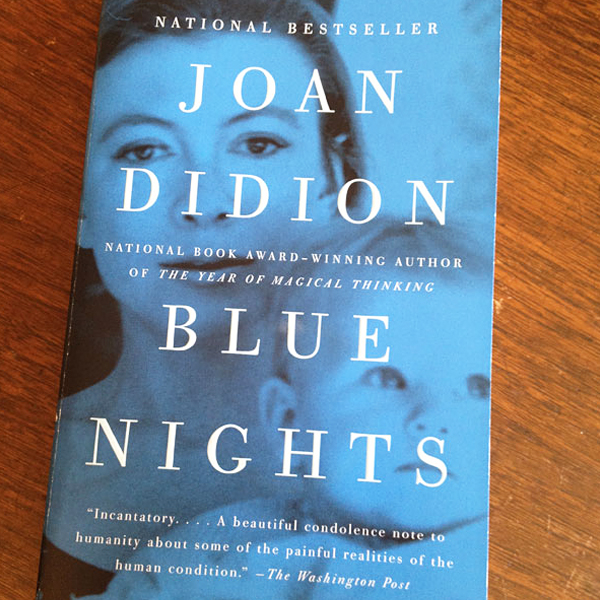
The Best Parts of Blue Nights by Joan Didion

The Best Parts of Blue Nights by Joan Didion | Mighty Girl

My favorite parts of Blue Nights, Joan Didion’s memoir on her daughter Quintana’s death.

Do not whine, I write on an index card. Do not complain. Work harder. Spend more time alone.

I have watched tears flood the eyes of grown women, loved women, women of talent and accomplishment, for no reason other than that a small child in the room, more often than not an adored niece or newphew, as just described them as “wrinkly,” or asked how old they are.

It was a time of my life during which I actually believed that somewhere between frying the chicken to serve on Sara Mankiewicz’s Minton dinner plates and buying the Porthault parasol to shade the beautiful baby girl in Saigon I had covered the main “motherhood” points.

The very definition of success as a parent has undergone a telling transformation: we used to define success as the ability to encourage the child to grow into independent (which is to say into adult) life, to “raise” the child, to let the child go.

A doctor to whom I occasionally talk suggests that I have made an inadequate adjustment to aging.
Wrong, I want to say.
In fact I have made no adjustment whatsoever to aging.

My mother’s name was already on the marble wall at St. John the Divine.
John’s name was already on it.
There had been two spaces remaining, the names not yet engraved.
Now there was one.

Vocabulary
baffle (n.) Something that balks, checks, or deflects.

Bird By Bird by Anne Lamott

The best parts of Bird by Bird: Some Instructions on Writing and Life:

“You might as well fall flat on your face as lean over too far backwards.” -James Thurber

There is a door we all want to walk through, and writing can help you find it and open it. Writing can give you what having a baby can give you: it can get you to start paying attention, can help you soften, can wake you up.

E. L. Doctorow once said that “writing a novel is like driving a car at night. You can only see as far as your headlights, but you can make the whole trip that way.” You don’t have to see where you’re going, you don’t have to see your destination or everything you will pass along the way. You just have to see two or three feet ahead of you. This is right up there with the best advice about writing, or life, I have ever heard.

The first time you read through your galleys is heaven. The second time through, all you see are the typos no one caught. It looks like the typesetter typed it with frostbitten feet, drunk. And the typos are important ones. They make you look ignorant; they make you look like an ignorant racist.

Try looking at your mind as a wayward puppy that you are trying to paper train. You don’t drop-kick a puppy into the neighbor’s yard every time it piddles on the floor. You just keep bringing it back to the newspaper. So I keep trying gently to bring my mind back to what is really there to be seen, maybe to be seen and noted with a kind of reverence. Because if I don’t learn to do this, I think I’ll keep getting things wrong.

Annie Dillard has said that day by day you have to give the work before you all the best stuff you have, not saving up for later projects.