California Sunday

Have you heard about California Sunday Magazine? It looks to be amazing, and they’re hiring writers and editors right now. The print and online magazine is a project by Doug McGray, “Editor” of the Pop-Up Magazine events, and Chas Edwards, a Co-Founder of Federated Media, and Person I Like Very Much. I am excited.

Also, Federated Media — the ad network that made it possible for me to make a living as a blogger — sold yesterday! It’s one of those making-doing-going weeks. Put your back into it, Internet.

Fellow Mortals by Dennis Mahoney

Fellow Mortals is my friend Dennis Mahoney‘s first novel, and it’s one of Booklists Top Ten First Novels of 2013. Go Dennis!

A few of my favorite parts:

Eventually it struck him: she was out there, right that minute, in a coffin underground less than twenty minutes from the motel, her clothes and hair all perfectly arranged and it was possible — unthinkable but possible — to see her face and even hold her hand.

Nan and Ava bristled from the start. They’re electrically polite, vying for dominion, Nan asserting her rights within the boundaries of decorum, Ava mastering her home with limits and concessions. This morning they offered each other first use of the washing machine with so much crackling generosity that Wing tucked tail and hid beneath a table.

The oven smells warm; it makes the kitchen like a bedroom. Evaporated milk cans open with a kiss. There’s a little spot of pumpkin at the button of her cuff and a faint taste of flour when he pecks her on the neck.

“I never would have guessed,” he said. “You seem so fertile.”
“I have breeding hips.”
He laughs and says, “That isn’t what I meant.”
She puts a hand to her stomach, following a breath, picturing her body full of daffodils and fruit.

… the light looks pale — more factual than warm.”

VOCABULARY

phoebe – an American tyrant flycatcher with mainly gray-brown or blackish plumage.
iliac crest – The upper edge of the pelvic bone
scud – move fast in a straight line because or as if driven by the wind.
sough – a moaning, whistling, or rushing sound as made by the wind in the trees or the sea.
chiminea – an earthenware outdoor fireplace shaped like a light bulb, with the bulbous end housing the fire and typically supported by a wrought-iron stand.

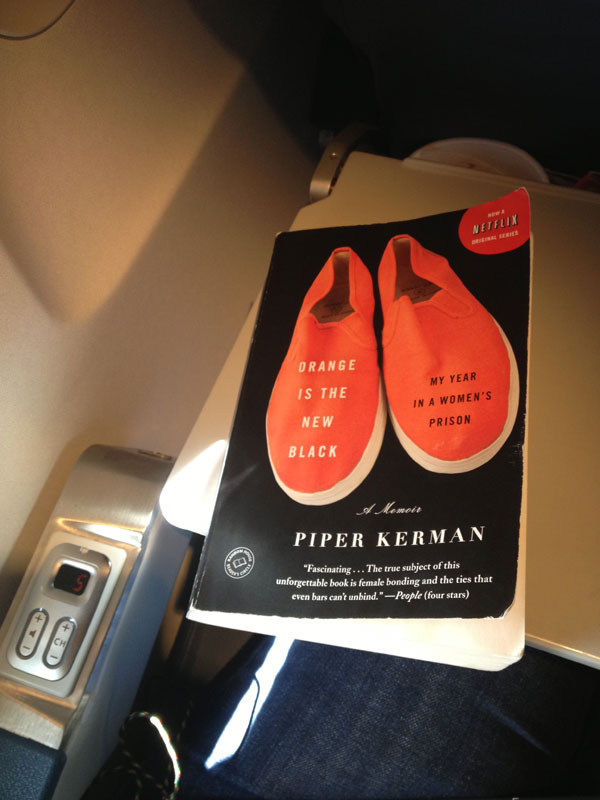
Orange is the New Black, by Piper Kerman

Piper and Larry are speaking at Camp Mighty next week! This is mostly because everyone around me would not shut up about how good the book and movie are.

It’s possible I’m the last person I know to read Orange is the New Black. It’s a smart, first-hand account on the need for prison reform in the U.S., but it surprised me by reinforcing some of the lessons from Viktor Frankel’s account of his time in a concentration camp — specifically our freedom to choose an honorable path even when all other freedoms are removed.

The best parts of Orange is the New Black by Piper Kerman:

In my travels I had encountered all kinds of people whose dignity seemed to have a price – widely variable – and I thought that next time I had better set my price higher than anyone would pay.

We now lock up one out of every hundred adults, far more than any other country in the world.

I was getting wet, and it was cold. Still, I was curious about these two. “Kinda crap weather out here.”
At this they looked at each other. “We ain’t felt the rain for two years,” said Jae, the black woman.
“What?”
“In Brooklyn there’s a little rec deck they take us up on, but it’s covered over, barbed wire and shit, and you don’t really see the sky,” she explained. “So we don’t mind the rain. We love it.” And she put her head back again, face up, as close to the sky as it could get.

In Danbury I had learned to hasten the days by chasing the enjoyment in them, no matter how elusive. Some people on the outside look for what is amiss in every interaction, every relationship, and every meal; they are always tying to hang their mortality on improvement. It was incredibly liberating to instead tackle the trick of making each day fly more quickly.

Prison is quite literally a ghetto in the most classic sense of the word, a place where the U.S. government now puts not only the dangerous but also the inconvenient – people who are mentally ill, people who are addicts, people who are poor and uneducated and unskilled.

Rose, chatting in the midst of a pedicure one day, told me what she had learned from her faith; I thought later that hers were the most powerful words a person could utter, “I’ve got a lot to give.”

It’s not easy to sacrifice your anger, your sense of being wronged.

Now here, in my third prison, I perceived an odd truth that held for each: no one ran them… for the prisoners, the people who lived in those prisons day in and day out, the captain’s chair was vacant, and the wheel was spinning while the sails flapped… The leadership vacuum was total.
What is the point, what is the reason, to lock people away for years, when it seems to mean so very little, even to the jailers who hold the key? How can a prisoner understand their punishment to have been worthwhile to anyone, when it’s dealt in a way so offhand and indifferent?

VOCABULARY
“she let that girl know what time it was” — clocked her, hit her
“feeling some kind of way” – feeling down, not yourself

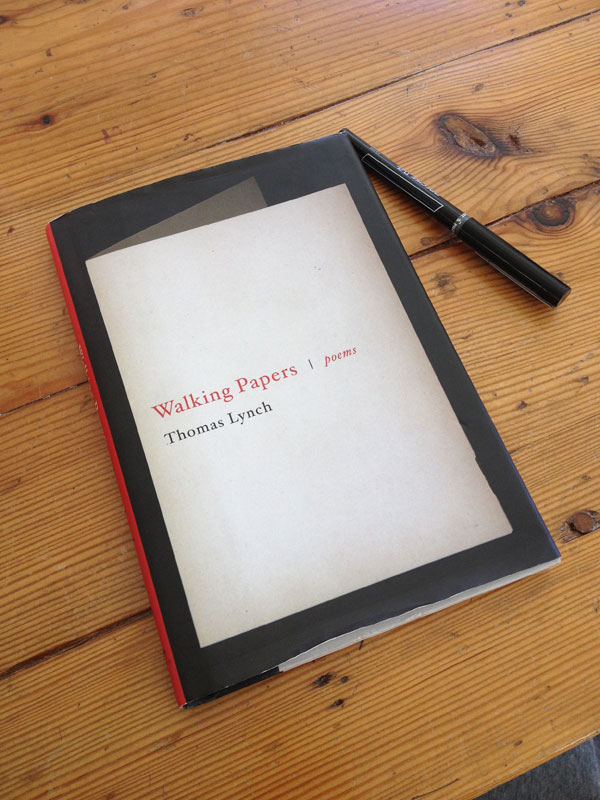
Walking Papers by Thomas Lynch

Thomas Lynch is one of my favorite authors, so I wrote him a thank you note a few months ago. To my surprise, he sent me a few of his books as a gift, thereby cementing my affection for him. I’ve been working my way through them.

Lynch is an undertaker, so much of his work deals with mortality. My favorite poem from Walking Papers by Thomas Lynch:

Local Heros

Some days the worst that can happen happens.
The sky falls or evil overwhelms or
the world as we have come to know it turns
toward the eventual apocalypse
long predicted in all the holy books —
the end-times of old grudge and grievances
that bring us each to our oblivions.
Still, maybe this is not the end at all,
nor even the beginning of the end.
Rather, one more in a long list of sorrows
to be added to the ones thus far endured,
through what we have come to call our history —
another in that bitter litany
that we will, if we survive it, have survived.
God help us who must live through this, alive
to the terror and open wounds: the heart
torn, shaken faith, the violent, vengeful soul,
the nerve exposed, the broken body so
mingled with its breaking that it’s lost forever.
Lord send us, in our peril, local heroes.
Someone to listen, someone to watch, someone
to search and wait and keep the careful count
of the dead and missing, the dead and gone
but not forgotten. Some days all that can be done
is to salvage one sadness from the mass
of sadnesses, to bear one body home,
to lay the dead out among their people,
organize the flowers and casseroles,
write the obits, meet the mourners at the door,
drive the dark procession down through town,
toll the bell, dig the hole, tend the pyre.
It’s what we do. The daylong news is dire —
full of true believers and politicos,
bold talk of holy war and photo-ops.
But here, brave men and women pick the pieces up.
They serve the living, caring for the dead.
Here the distant battle is waged in homes.
Like politics, all funerals are local.

The Great Gatsby by F. Scott Fitzgerald

The movie irritated me, but I hadn’t read the book since college, and couldn’t remember much about it. It was strange reading my old copy where I’d underlined a bunch of passages that don’t resonate with me any more, and every reference to color — I must have been working on a paper.

Newsflash, The Great Gatsby is terrific. The kind of book that makes you want to find the author and grin stupidly in his face.

The best parts of The Great Gatsby:

Conduct may be founded on the hard rock or the wet marshes, but after a certain point I don’t care what it’s founded on. When I came back from the East last autumn I felt that I wanted the world to be in uniform and at a sort of moral attention forever.

Continue reading “The Great Gatsby by F. Scott Fitzgerald”

Man’s Search for Meaning by Viktor E. Frankl

Dr. Frankl was psychiatrist and a concentration camp prisoner during WWII. I read Man’s Search for Meaning just out of college, but recently decided to reread it because I’ve been thinking about the differences between being happy and feeling that your life has meaning. A few of the parts that resonated most with me:

… Success, like happiness cannot be pursued; it must ensue, and it only does so as the unintended side-effect of one’s dedication to a cause greater than oneself or as the by-product of one’s surrender to a person other than oneself. Continue reading “Man’s Search for Meaning by Viktor E. Frankl”